

By: Dr. Ichwan Anggawirya, S.Sn., S.H., M.H.
In Intellectual Property law practice, one of the most common misconceptions is the view that possession of a physical object is identical to possession of all rights attached to that object. For example, purchasing a painting is often understood as a basis for reproducing that painting. Similarly, receiving the source code of a computer program is frequently perceived as a basis for full ownership or control of the program. However, the legal construction of Intellectual Property clearly distinguishes between possession of an object and the rights attached to that object. The same misunderstanding often arises from the assumption that payment for a work automatically results in the transfer of all rights attached to that work. From a legal perspective, ownership of a physical object and ownership of the rights attached to that object are two distinct concepts and do not always overlap.
Such views actually stem from an incorrect understanding of the concept of property in law. In everyday life, objects are often understood as something that can be seen, touched, and physically possessed. However, the law views the concept of objects much more broadly than mere tangible items. Article 499 of the Civil Code essentially states that property includes all goods and all rights that can be owned. This provision indicates that the law not only recognizes objects with physical form but also recognizes rights that have economic value and can be the subject of legal relations.
This understanding is reinforced by Article 503 of the Civil Code, which distinguishes between corporeal and incorporeal property, and Article 504 of the Civil Code, which distinguishes between movable and immovable property. From this construction, it is evident that the law has long recognized the existence of rights as property, even if these rights do not have a physical form that can be seen or touched. Thus, the development of the concept of property actually shows that the law is not solely oriented towards the physical existence of an object, but also towards the object's ability to be the center of legal relations and to have economic value that can be defended and transferred.
In property law doctrine, a distinction is made between corpus and incorporeal rights. Corpus refers to physical objects that can be seen and touched, while incorporeal rights refer to rights attached to or related to those objects. This distinction is crucial because ownership of the corpus does not always result in the transfer of incorporeal rights. In the Intellectual Property regime, the main economic value often lies in these intangible rights, not in the physical media that contain them.
The development of the modern economy further emphasizes the importance of this concept. In the past, sources of wealth generally came from land, buildings, production machinery, or natural resources. However, in a knowledge-based economy, most economic value comes from assets that do not have a physical form. Trademarks, software, algorithms, databases, designs, formulas, works of art, and various other forms of Intellectual Property often have much greater value than the physical assets a company owns. This phenomenon can be seen in various global technology companies whose market value is not primarily determined by their office buildings, computers, or equipment. Instead, most of the company's value lies in intangible assets such as brands, technology, software, copyrights, patents, user bases, and various other forms of intellectual property.
This shift indicates that the center of gravity of the modern economy has moved from tangible assets to intangible assets. In many cases, the value of a company's brand can even exceed the value of all its physical assets. The same applies to software, works of art, industrial designs, formulas, and various other forms of intellectual works. Therefore, understanding intangible assets is no longer just an academic necessity but a practical necessity in the modern business and investment world.
In this context, Intellectual Property Rights hold a very unique position. On one hand, these rights do not have a physical form. On the other hand, they have real economic value, can be owned, transferred, inherited, licensed, pledged, and are the subject of commercial transactions. Therefore, the law recognizes them as property with their own economic value. This recognition shows that the protection of Intellectual Property not only aims to protect creativity but also to protect the economic investments born from that creativity.
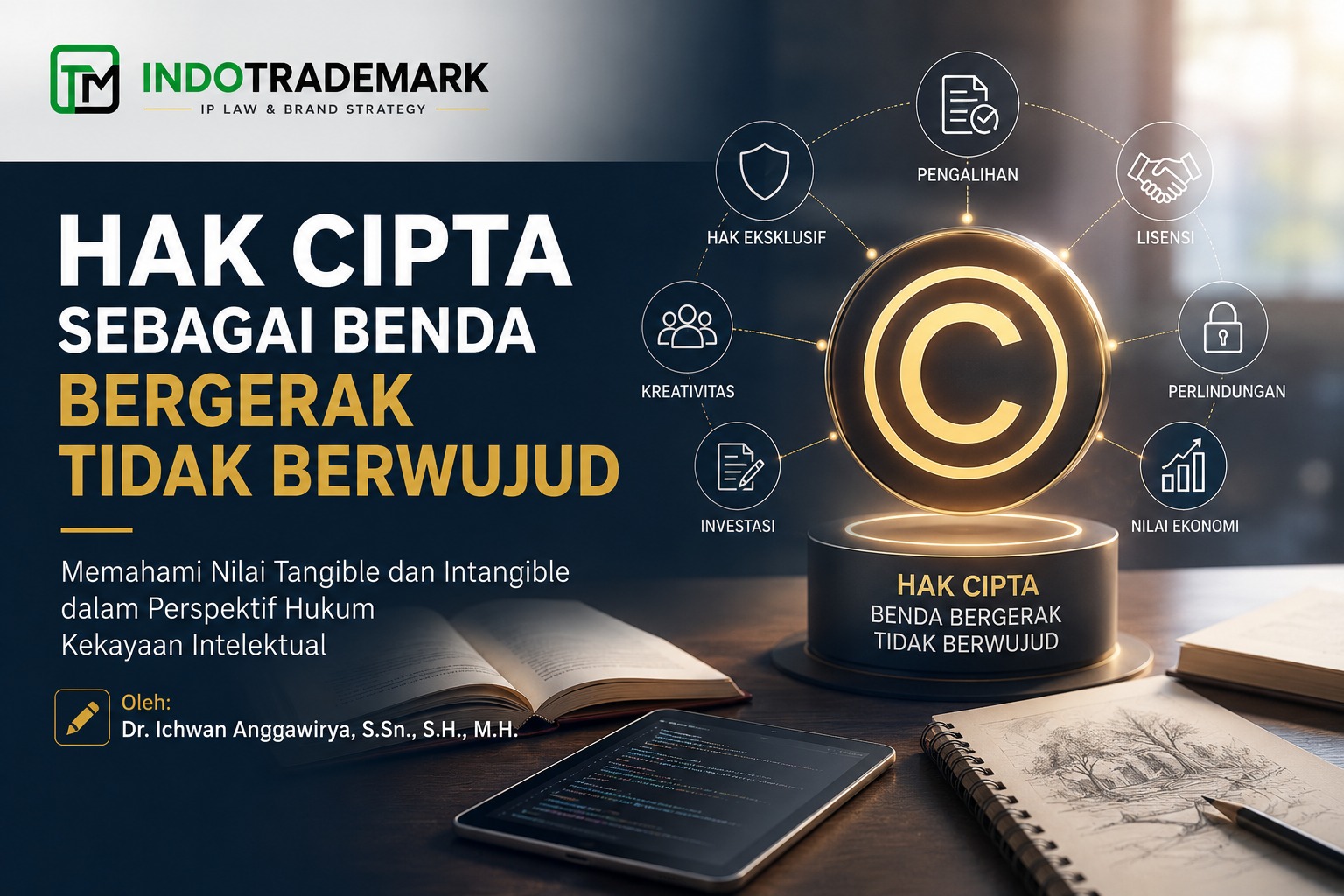
The most definitive recognition can be found in Article 16 paragraph (1) of Law Number 28 of 2014 concerning Copyright, which states that Copyright is an intangible movable property. This provision is of great importance because it positions Copyright not merely as a personal relationship between the creator and their creation, but also as an asset with property characteristics and economic value. As intangible movable property, Copyright can be the subject of transfer, inheritance, gift, will, and even, based on legal provisions, can be used as an object of fiduciary security.
The recognition of Copyright as intangible movable property actually reflects a fundamental paradigm shift. Intellectual works are no longer viewed solely as the result of creativity that needs protection, but also as assets that can be managed, valued, traded, commercialized, and become a source of sustainable economic value creation. Thus, Copyright not only has a legal protection dimension but also an investment and asset management dimension.
To understand why Copyright has high economic value, it is necessary to understand the relationship between human capital, intellectual capital, and intellectual property. Before a creation comes into being, there is a long investment in the form of education, experience, research, training, creativity, experimentation, and the development of intellectual abilities. All of these investments are known as human capital.
When this knowledge and experience accumulate into abilities capable of creating economic value, intellectual capital is born. Subsequently, when the results of these abilities are embodied in a work that obtains legal protection, intellectual property or Intellectual Property is born. Thus, Copyright is essentially a legal manifestation of the accumulation of human capital and intellectual capital built over many years by its creator.
A computer program developed over many years does not just represent millions of lines of code. It contains thousands of hours of research, testing, failures, refinements, practical experience, technical knowledge, and creativity accumulated during its development process. Its economic value is not derived from its storage medium, but from the intellectual capital contained within it. The higher the level of complexity and economic benefit, the greater the intangible value attached to the program.
The simplest example can be found in books. When someone buys a book, what they actually acquire is ownership of the physical copy of the book, including the paper, ink, cover, and binding. The buyer does not automatically acquire the Copyright to the content of the book. They are not entitled to reproduce, republish, translate, adapt, or upload the entire content of the book to the internet without permission from the Copyright holder. These exclusive rights remain with the creator or Copyright holder even though the physical book has changed hands.
The same principle applies to visual art. Someone who buys a painting acquires ownership of the canvas and paint that form the painting. However, ownership of this physical object does not automatically result in the transfer of Copyright. Without a valid transfer of Copyright, the buyer is not automatically entitled to reproduce the painting in the form of posters, digital reproductions, merchandise, or other forms of commercial exploitation.
The distinction between tangible and intangible property becomes even more important in the context of computer programs. In information technology practice, it is often assumed that the delivery of source code is equivalent to the transfer of Copyright. However, these two are not always the same. The delivery of source code essentially constitutes the delivery of access to or a copy of a computer program creation and does not automatically result in the transfer of Copyright or the economic rights attached to it. The Copyright and economic rights attached to the computer program remain with the creator or rights holder, unless there is a valid transfer based on a written agreement or applicable legal provisions.
One of the misconceptions still frequently found in business practice is the assumption that payment for a work automatically results in the transfer of Copyright. However, payment and transfer of Copyright are two different legal events. Payment can be the basis for the creation of a right of use, a right of access, or a specific right of utilization, but it does not always result in the transfer of economic rights if there is no legal basis or agreement that explicitly regulates it.
The main value of a computer program does not lie in the server, laptop, hard disk, or other storage media. In fact, the economic value of a computer program does not solely lie in the possession of the source code. The true value lies in the rights attached to the computer program as a legally protected creation, especially the economic rights to use, reproduce, modify, license, distribute, and commercialize it. Therefore, possession of the source code is not always identical to possession of the economic rights attached to the computer program. In many cases, the value of the hardware and storage media may only be a few million rupiah, while the value of its economic rights can reach billions or even tens of billions of rupiah.
From an economic perspective, this difference is closely related to the concept of tangible and intangible value. Tangible value is the value inherent in physical objects and can generally be calculated based on the cost of raw materials, production costs, or market prices. Conversely, intangible value is value that does not have a physical form but is capable of generating economic benefits. In Copyright, tangible value is often only a small part of the overall value of a work. The greatest value lies in the economic rights that allow a creation to generate recurring and sustainable income.
Therefore, the value of a Copyright cannot always be measured by its creation cost. A computer program developed with hundreds of millions of rupiah in costs can have a value of billions of rupiah if used by many users and generates recurring revenue in the long term. Conversely, a work with high creation costs may not necessarily have great economic value if it lacks adequate commercialization potential.
In the practice of Intellectual Property valuation, there are three main approaches: the Cost Approach, the Market Approach, and the Income Approach. The Cost Approach values a work based on the cost required to create or replace it. The Market Approach uses comparable transactions of a similar nature. Meanwhile, the Income Approach values a work based on its ability to generate future income. For many Copyright assets, the Income Approach is often considered the most capable of reflecting their economic value because it focuses on the economic benefits that will be derived from the exploitation of the creation.
In the era of a knowledge-based economy, the greatest wealth is often not stored in buildings, machines, or land, but in ideas, creativity, knowledge, experience, and innovations that obtain legal protection as Intellectual Property. Therefore, understanding Copyright as intangible movable property is not merely a matter of legal terminology. This understanding is key to understanding how economic value is created, managed, defended, transferred, and protected in the modern economy. What is truly valuable in a book is not its paper, what is valuable in a painting is not its canvas, and what is valuable in a computer program is not the medium that contains it. The true value lies in the exclusive rights that live behind the work. It is these rights that the law recognizes as intangible movable property and which, in many circumstances, become the most valuable assets owned by an individual or a company.
IndoTrademark IP Law & Brand Strategy