

Dr. Ichwan Anggawirya, S.Sn., S.H., M.H.
In contemporary branding practices, there is an interesting phenomenon where some companies build their brand identity through words that are linguistically considered non-standard, unusual, or appear as deviations from commonly known spellings. Although often perceived as a form of writing "error," such modifications are in fact frequently designed intentionally as part of a branding strategy to create a more distinctive, memorable identity with strong market differentiation.
This phenomenon indicates that in branding strategy, linguistic deviations are not always synonymous with weakness. In certain contexts, spelling modifications can become a highly effective differentiation tool.
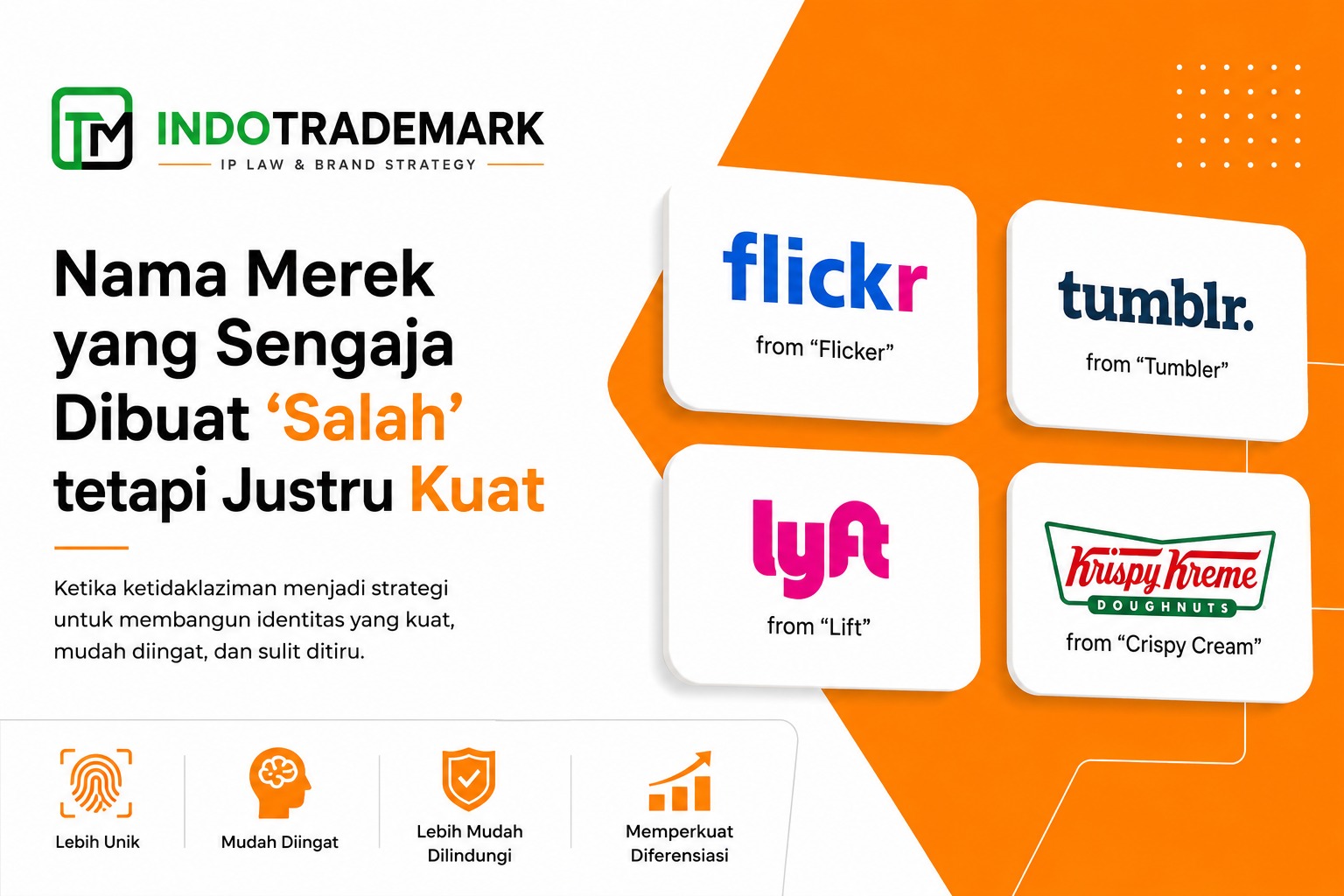
This type of branding practice can be found in various global brands, including:
-
Flickr — a digital photo-sharing platform
(derived from the word "Flicker") -
Tumblr — a microblogging and social media platform
(derived from the word "Tumbler") -
Lyft — a transportation and ride-sharing service
(derived from the word "Lift") -
Krispy Kreme — a donut and fast-food brand
(derived from the phrase "Crispy Cream")
Some of these names are constructed through the omission of vowels, phonetic changes, or deliberate spelling modifications to sound more distinctive than their standard forms. In the context of branding, such deviations are not merely viewed as linguistic errors but as differentiation strategies to build a more unique, recognizable identity that stands out in market competition.
In branding science, this approach is closely related to the concept of distinctiveness, which is the ability of an identity to appear different in the consumer's memory. Psychologically, the human brain tends to remember things that are unique, odd, or slightly deviate from the general pattern more easily. This is where unusual brand names often gain stronger differentiation power in consumer memory.
For example, Lyft intentionally modified the word "Lift" to "Lyft." While the change may seem simple, it results in a more distinctive visual and phonetic identity. Besides being easier to protect legally, the name also builds an impression of modernity, digital presence, and closeness to the tech startup culture.
A similar approach can be seen with Flickr, which omitted the last vowel from the word "Flicker." This strategy was quite popular in the early days of internet company development as it helped create shorter, unique, and more easily securable digital domain names.
Meanwhile, Tumblr modified the word "Tumbler" by omitting a vowel, resulting in a more concise and modern visual form. This approach became a trend during the Web 2.0 era as it was considered capable of creating a more distinctive digital identity that stood out among many tech startups.
Krispy Kreme, on the other hand, uses a modified spelling of the phrase "Crispy Cream." Although linguistically non-standard, the combination creates a more playful, memorable identity with a strong commercial character.
From a trademark law perspective, this strategy also offers significant advantages. Names that are too generic, too descriptive, or too common are often more difficult to protect legally because they are considered to lack distinctiveness. Conversely, creatively modified words can strengthen the differentiating element as a commercial identity.
This is why many modern companies deliberately avoid using entire dictionary words. They opt for letter modifications, vowel omissions, phonetic plays, or the creation of semi-abstract terms to make their brands more unique visually, audibly, and legally.
However, this strategy cannot be implemented carelessly. Names that are too complex, too difficult to read, or too foreign can cause phonetic friction, which is a psychological barrier when consumers try to pronounce or remember a brand. In branding practice, the balance between uniqueness and readability remains a crucial factor.
Thus, the strength of such a strategy lies not merely in its "unusualness" but in its ability to build a distinct, recognizable identity that creates a strong emotional connection in the market's mind.
This strategy also demonstrates that branding does not always strictly adhere to formal linguistic rules. In many cases, perception, memorability, identity differentiation, and the brand's associative power are far more decisive factors than mere linguistic spelling accuracy.
IndoTrademark IP Law & Brand Strategy