

 Jakarta - The aroma of coffee brings much fortune, from coffee plantations to coffee shop businesses. From the roadside to cafes and star-rated hotels. This business opportunity also leaves a story of trademark disputes for KOPITIAM, which literally means 'coffee shop'.
The case began to surface publicly after Abdul Alek Soelystio registered his coffee shop under the name 'KOPITIAM'. This trademark is written in all capital letters with orange and distinctive lettering. The world of kopitiams became even more heated when Abdul Alex announced in a national print media on February 28, 2012, that his party owned the trademark rights to 'KOPITIAM'.
The owners of kopitiams were surprised, wondering how the government could grant trademark rights to a word that is common property or in the public domain. As a result, many parties sued the Minister of Law and Human Rights as the party that issued the trademark permit, including suing Abdul Alex.
One of them is Pamin Halim, the owner of Kok Tong Kopitiam. According to him, the spelling of 'Kok Tong Kopitiam' is very different from the spelling of the 'KOPITIAM' trademark ala Abdul Alex. Despite the significant difference, the Supreme Court at the cassation level still ruled that the coffee shop 'Kok Tong Kopitiam' had substantial similarity with the coffee shop 'KOPITIAM'.
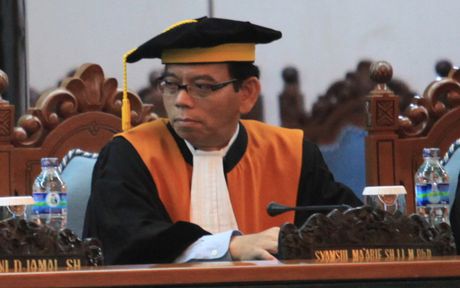
This decision was adjudicated by 5 supreme court justices: Prof Dr Vallerina JL Kriekhoff Syamsul as the presiding judge, and Syamsul Ma'arif PhD, I Made Tara, and Mahdi Soroinda Nasution with Dr Nurul Elmiyah as associate justices. In the decision rendered on March 20, 2013, the cassation panel was divided. The five justices did not have a unanimous opinion regarding the trademark rights of KOPITIAM owned by Alex. Supreme Court Justice Syamsul opined that KOPITIAM could not be granted exclusive rights.
"'KOPITIAM' is a word commonly used by the Malay community for a shop that sells coffee, so all coffee shops are essentially entitled to use this word to complement their trade names," said Syamsul in his considerations on page 64 as quoted by detikcom, Thursday (16/4/2015).
Therefore, still within Syamsul's considerations, in the current case, the dominant element in determining the presence or absence of substantial similarity between the Kok Tong Kopitiam trademark owned by the cassation applicant and the KOPITIAM trademark owned by the respondent is not the word KOPITIAM, but the word Kok Tong.
"Therefore, the applicant's trademark does not have substantial similarity with the respondent's KOPITIAM trademark. There was a clear error in the lower court's decision," stated Syamsul in his verdict on March 20, 2013.
Not only Syamsul, but Nurul also had a similar view. That is, kopitiam is a combination of the word 'kopi' (coffee) in Malay. Meanwhile, 'tiam' comes from the Hokkien language, meaning shop. This proves that the word kopitiam is a generic word/commonly used.
"Because it is generic, it cannot be regulated under the Trademark Law," emphasized Nurul.
After 2 years passed, Supreme Court Justice Syamsul changed his opinion regarding the 'KOPITIAM' trademark. This happened when Syamsul adjudicated the case of Phiko Leo Putra, the owner of Lau's Kopitiam, versus KOPITIAM. This time, Supreme Court Justice Syamsul sided with KOPITIAM. Together with Prof Dr Takdir Rahmadi and Hamdi, Syamsul, as the presiding judge, stated that Lau's Kopitiam had similarities with KOPITIAM and ruled that Phiko must change his shop's trademark.
"Declares that Phiko Leo Putra has committed an unlawful act by using the unregistered trademark Lau's Kopitiam without authorization, which has substantial similarity with the KOPITIAM trademark owned by the counter-claimant," thus ruled the cassation panel.
The verdict was rendered on January 21, 2015. So, is it true that Lau's Kopitiam has similarities with KOPITIAM? Here are images of the two trademarks.
Source: detik.com