

Dr. Ichwan Anggawirya, S.Sn., S.H., M.H.
One of the fundamental issues that often leads to disputes in copyright law practice is the lack of clear understanding regarding the relationship between the party financing the creation of a work, the party creating the work, and the party entitled to economic benefits from it. In business practice, these three concepts are often treated as identical, whereas each has a different philosophical basis and legal consequences.
This lack of clarity is even more apparent in works created through employment relationships, commissioned projects, or commercial collaborations. It is not uncommon for one party to assume that payment for a job automatically makes them the copyright owner, while another party believes that the right remains with the creator because the work stems from their intellectual ability and creativity. This difference in perspective is what subsequently becomes the source of various copyright disputes, including in the information technology and computer program development industries.
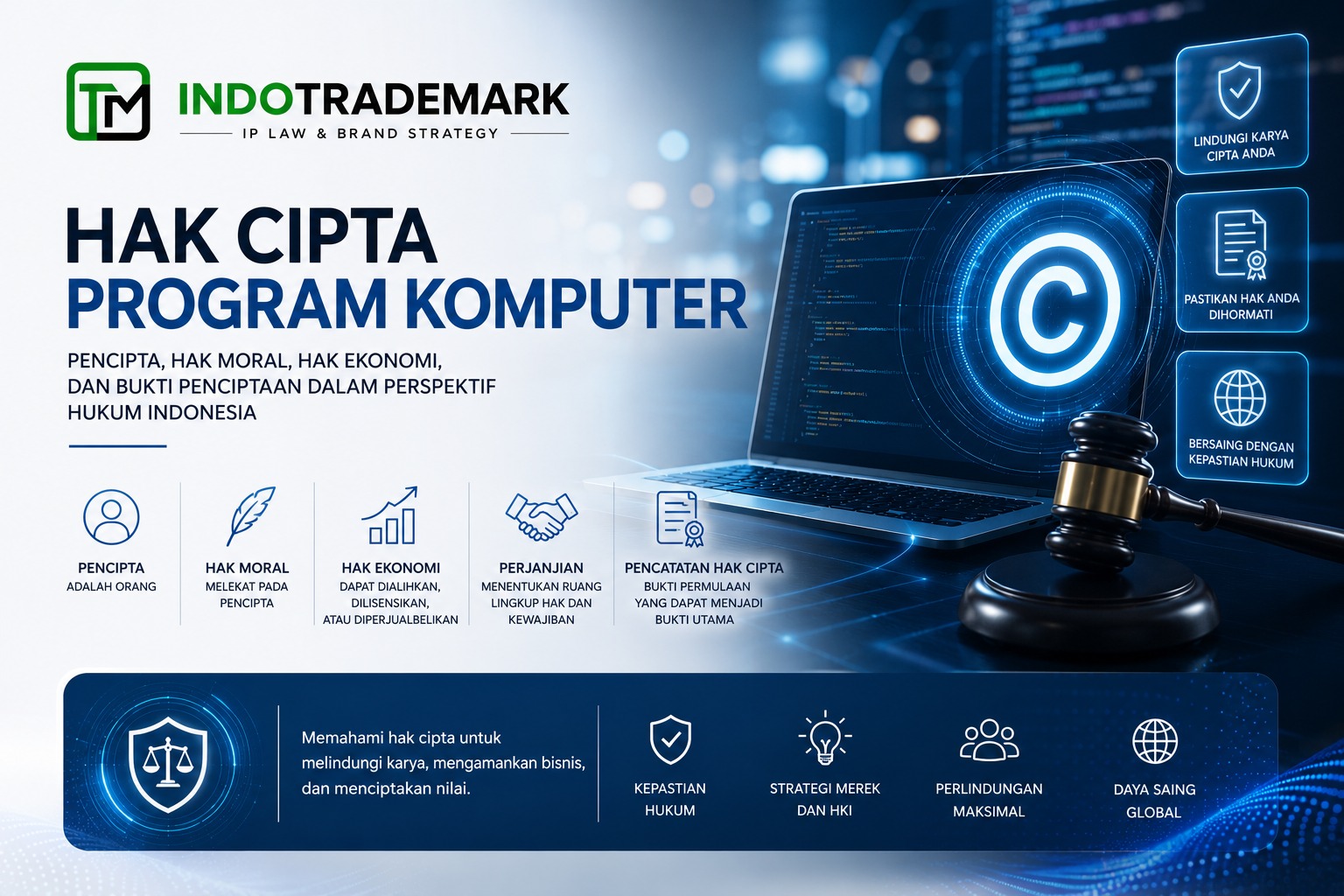
To understand this issue correctly, it is first necessary to grasp that copyright does not exist as a single, monolithic right. The Copyright Law recognizes two distinct sets of rights: moral rights and economic rights. Both arise from the same creation but have characteristics, functions, and legal consequences that are not always identical.
Moral rights are rights that are personally attached to the creator as a form of recognition for the intellectual connection between the creator and their creation. Through moral rights, a creator is entitled to be identified by their name, to maintain the integrity of their creation, and to object to any changes that may harm their honor or reputation. Due to their personal nature, moral rights fundamentally remain with the creator and cannot be treated the same as tangible property or assets that are freely traded.
On the other hand, economic rights are rights that empower the copyright holder to obtain economic benefits from a creation. These rights include, among others, the right to reproduce, distribute, publish, adapt, license, or grant permission for the use of a work to others. Unlike moral rights, economic rights are generally transferable, licensable, inheritable, or contractually assignable in accordance with applicable laws.
The differing nature of moral and economic rights is significant in the drafting of contracts and commercial agreements. Payments made in a project do not automatically clarify which rights are actually being transferred. Some payments may merely be compensation for labor, time, expertise, or operational costs incurred in the creation process. In other situations, payments may be intended as remuneration for granting a license to use the work. Under certain conditions, payments may even be intended to transfer some or all of the economic rights to another party.
Therefore, the existence of a payment cannot automatically be interpreted as a transfer of copyright. What determines this is not merely the presence of payment, but rather how the parties formulate their rights and obligations in the agreement. The greater the economic value of a creation, the more crucial contractual clarity becomes regarding the scope of use, commercialization rights, licensing, profit sharing, and the possibility of future economic rights transfers.
In this context, Indonesian copyright law adopts a different approach compared to some other jurisdictions, particularly the United States, which recognizes the work for hire doctrine. In the US legal system, certain works created within an employment relationship can automatically be considered owned by the employer. Such an approach is not automatically recognized in the Indonesian legal system.
Law Number 28 of 2014 concerning Copyright places the creator at the center of legal protection. Article 1, point 2, defines a creator as an individual or individuals who, independently or jointly, produce a creation that is distinctive and personal. Consequently, the creator is always a human being as the subject who undertakes the intellectual and creative process. Legal entities, limited liability companies, foundations, associations, or other organizations can be holders of certain rights, but they cannot engage in the act of creation as humans do.
This principle is further reinforced by Article 36 of the Copyright Law, which states that, unless otherwise agreed, the creator and copyright holder of a work created in an employment relationship or based on a commission is the party who created the work. This provision indicates that Indonesian law does not automatically apply the work for hire concept as known in the US legal system.
In the practice of computer program development, this provision has very important implications. Many companies assume that payment for software development costs automatically makes the company the copyright owner of the software. However, payment for software development services, granting a license for use, and transferring economic rights are three distinct legal concepts and cannot be equated.
A company may obtain the right to use, operate, market, or even sell software based on a specific agreement without necessarily becoming the copyright owner of the software. Conversely, a developer or development team can remain the creator and copyright holder even after receiving payment for their work, as long as there is no explicit transfer of economic rights formulated in the agreement.
When disputes regarding software ownership arise, courts generally do not solely assess the contractual relationship or the flow of payments between the parties. Equally important is the existence of evidence demonstrating the intellectual process that led to the creation of the work. In copyright evidence practice, such evidence is commonly known as evidence of authorship, which refers to the traces of the creation process that show an individual's creative involvement in designing, developing, and realizing a work into a legally protectable form.
Evidence of the creation process can include a Product Requirement Document (PRD), system requirements analysis, software architecture design, flowcharts, wireframes, mockups, database schemas, source code, Git repositories, file metadata, document revision history, electronic correspondence, development meeting minutes, testing documentation, to system implementation records. All these documents form an intellectual trail that shows who designed, developed, and refined a computer program over time.
The more complete the evidence of the creation process an individual possesses, the stronger their position will be in proving their status as the creator. Therefore, documentation of the development process often holds significantly more evidentiary value than mere verbal claims about who first created a computer program.
Nevertheless, Indonesian copyright law still adheres to the declarative principle. Copyright protection arises automatically from the moment a creation is embodied in a tangible form, without requiring prior registration formalities. Thus, the absence of copyright registration does not negate the existence of a copyright that has legally arisen.
However, copyright registration remains very important in evidentiary practice. A copyright registration certificate can serve as prima facie evidence, providing a legal presumption of ownership of a creation. Even in certain circumstances, especially if the registration is done early and there is no other stronger evidence to refute it, a copyright registration certificate can gain significant evidentiary value and become one of the primary pieces of evidence in dispute resolution.
Therefore, copyright registration should not be viewed as a prerequisite for legal protection, but rather as a strategic instrument to strengthen legal certainty and simplify the proof process should disputes arise in the future.
Ultimately, a correct understanding of the differences between creator, copyright holder, moral rights, economic rights, usage licenses, and rights transfers is a crucial foundation in any legal relationship concerning intellectual works. Clarity on these aspects not only provides protection for creators but also creates legal certainty for investors, companies, users, and all parties involved in the utilization and commercialization of a creation.
IndoTrademark IP Law & Brand Strategy