

Dr. Ichwan Anggawirya, S.Sn., S.H., M.H.
Discussions about branding are generally associated with marketing strategies, consumer psychology, visual identity, and market positioning. However, interestingly, in many Asian countries, businesses still consider fengshui elements when determining brand names, logos, business numbers, and other commercial identities.
To some, fengshui in brand names is often seen merely as a traditional belief without a rational basis. However, upon further analysis from the perspective of consumer psychology and market behavior, this phenomenon actually possesses perceptual dimensions that are relevant enough for scientific discussion.
Essentially, branding operates within the realm of human perception. Consumers do not always make decisions solely based on rational considerations of product quality or price; they are also influenced by symbols, emotions, cultural associations, social suggestions, and psychological experiences embedded in their minds. It is in this context that fengshui in brand names often functions not merely as a traditional belief, but as a symbolic perception alive within society.
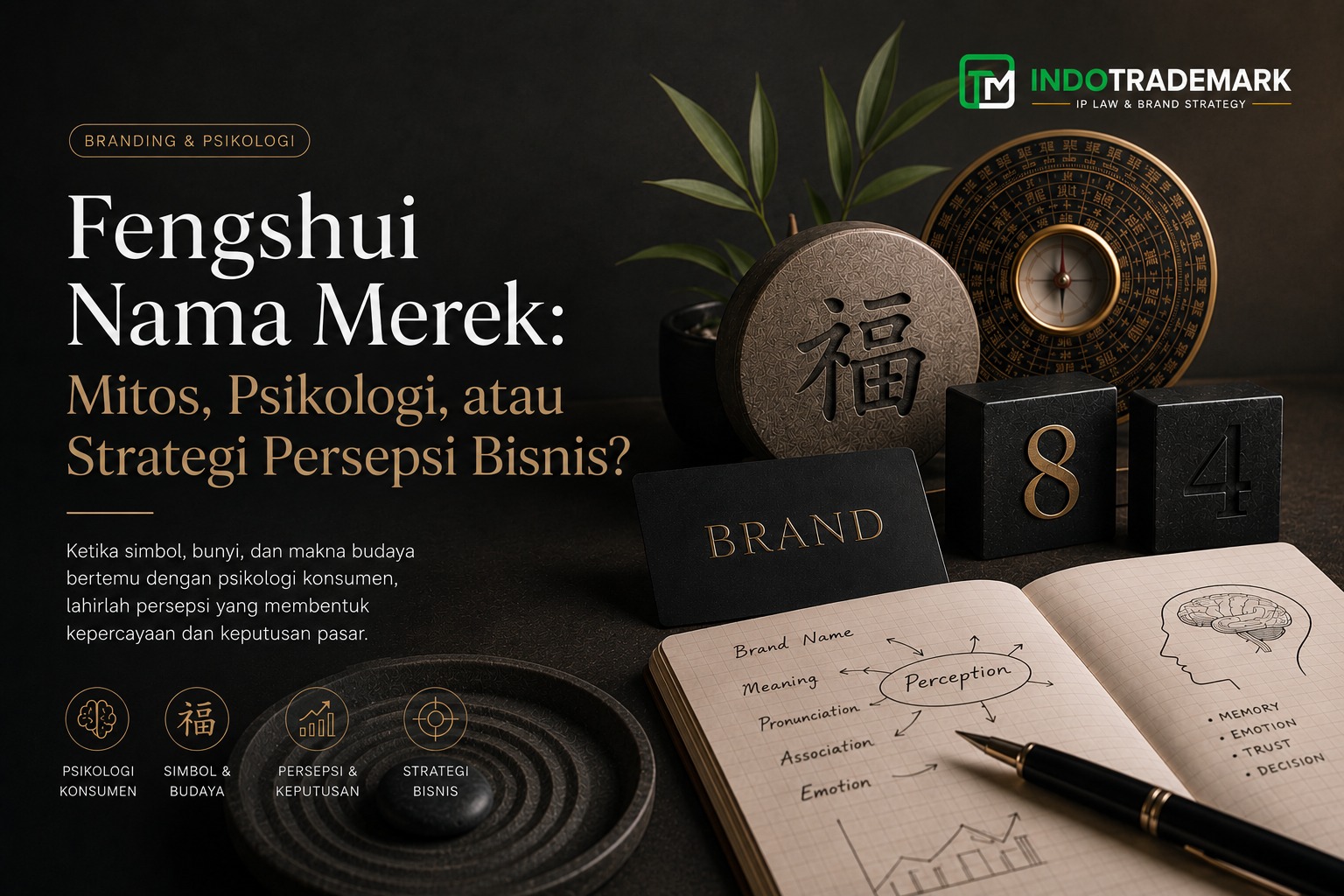
This can be observed in the use of certain numbers in business practices in Asia. For instance, the number 8, in Chinese culture, is widely associated with prosperity and good fortune because its pronunciation shares phonetic proximity with words meaning "to become rich" or "to prosper financially." On the other hand, the visual shape of the number 8, resembling an unbroken loop, further reinforces the symbolic perception of continuity, smoothness, and abundance. Conversely, the number 4 tends to be avoided due to its phonetic association with the word for "death."
Objectively, numbers are fundamentally mathematical symbols with no direct influence on business performance. However, in market practice, the collective perception of society towards certain symbols can indeed influence economic behavior. Various studies in behavioral economics show that humans tend to show a greater preference for symbols associated with positive cultural or emotional meanings.
Numerous consumer behavior studies in Asia indicate that the number "8" is frequently associated with good luck, influencing purchasing decisions, property prices, and business pricing strategies. Some property market studies have even found that apartment units or floor numbers containing the number 8 command higher selling prices than ordinary numbers, while the number 4 is relatively less desirable due to its associated psychological connotations.
A similar pattern is observed in pricing practices in several Asian businesses, where specific numbers are intentionally used to create a sense of comfort, harmony, or a perception of good fortune in the minds of consumers. This means that even if the symbol has no direct physical influence, the meaning it holds within societal perception can still significantly impact market behavior.
Interestingly, a relatively similar concept can also be found in modern Western branding practices, although not referred to as fengshui. In contemporary branding, various approaches such as sound symbolism, color psychology, and phonetic branding are known, all of which study how specific sounds, rhythms, symbols, and associations can shape consumer perception of a brand.
Examples can be seen in names like Rolex, Google, or Kodak. These names were not chosen without deep consideration but through a process that paid attention to sound rhythm, memorability, psychological feel, and the perceptual character intended for the brand identity.
Therefore, when some businesses in Asia consider fengshui in determining brand names, in many cases, it is not merely spiritual belief that is at play, but rather the psychological association that is alive within the society's culture. As long as the target market imbues certain symbols with emotional meaning, those symbols can indeed influence trust, emotional comfort, and positive perceptions of a business.
This phenomenon can also be explained through the psychological concept known as the self-fulfilling prophecy, which is a condition where an individual's belief in a symbol or identity ultimately influences their own behavior. In a business context, entrepreneurs who feel their brand name is "good," "harmonious," or "brings luck" often become more confident, optimistic, consistent, and bolder in making business decisions. Consequently, this belief can indirectly impact their business performance in a tangible way.
Furthermore, some modern fengshui approaches intersect with various scientific concepts such as environmental psychology, color psychology, consumer behavior, and cognitive fluency, which is the condition where the human brain tends to more easily accept things that feel harmonious, memorable, comfortable to pronounce, and visually or emotionally pleasing.
From this perspective, fengshui in brand names is more accurately understood as a blend of culture, collective perception, symbol psychology, and emotional association that thrives within society. Similar to modern branding practices, humans naturally tend to assign emotional meaning to specific sounds, colors, symbols, or identities.
From this viewpoint, it is also understandable why many modern businesses, including large corporations in Asia, still consider the harmony of names, numbers, colors, or specific visual identities in their business strategies. This occurs not solely due to cultural beliefs, but because in modern business practices, society's collective perception can indeed influence how the market builds trust in a brand.
On a certain level, the strength of a brand often stems not only from its product quality but also from the psychological meaning successfully embedded in public perception.
IndoTrademark IP Law & Brand Strategy